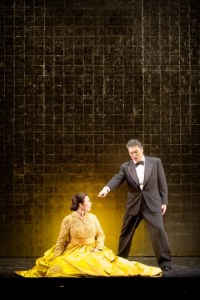
Irmgard Seefried - sopran
Hon fick sin utbildning i Augsburg och debuterade på operan i Aachen under Karajan.1943 kom hon till Wiener Staatsoper,som blev centrum för hennes operakarriär. Där tillhörde hon efterkrigstides berömda Mozartensemble och betraktades som den idealiska Susanna i Figaros bröllop, Pamina i trollflöjten och Fiordiligi i Cosi fan tutte. 1944 sjöng hon till Richard Strauss stora uppskattning kompositören i Ariadne på Naxos vid festföreställningen på hans 80-årsdag, och hon var senare en berömd Octavian i Rosenkavaljeren.1946-60 var hon fast gäst i Salzburg och sjöng också en säsong på Metropolitan.
In English
Born: October 9, 1919 - Köngetried, near Mindelheim, Bavaria, Germany
Died: November 24, 1988 - Vienna, Austria
The outstanding German soprano, Irmgard Seefried, received her first music lessons from her father and at the age of 11, three years after her first public appearance, sang Gretel in Engelbert Humperdinck’s opera. Later she studied at the Augsburg Conservatory.
Irmgard Seefried made her debut in 1939 (or 1940) at the Aachen Stadttheater as Priestess in Aida. She was engaged for that opera house by Herbert von Karajan. While at Aachen she also sang in performances at the cathedral, under Theodor Rehmann. In 1943 she made her debut at the Vienna State Opera as Eva in Die Meistersinger under Karl Böhm, and then remained a member of the company (1953-1954). She appeared at the Covent Garden Opera in London from 1947 to 1949, and also in Milan (La Scala), Salzburg, Edinburgh, etc. She made her Metropolitan Opera in New York debut in November 1953 as Sussana in Le Nozze di Figaro and appeared there for 1 season (1953-54), in 5 performances and 1 work.
Irmgard Seefried had a very distinctive voice and a totally natural delivery. Her warm tone and appealing personality made her a successful Susanna, Fiodiligi, Eva, and Cleopatra, Giulio Cesare, and she was an admired Lieder singer. She was instrumental in the rediscovery, after the war, of Mozart’s Lieder, which had always been disparaged as trifles and Das Veilchen featured in so many of her recital performances. Elisabeth Schwarzkopf, her colleague of many legendary Salzburg Mozart performances of the 1950’s, suggested that everyone, including herself, was a little envious of Seefried for her naturalness. ”Singing just came so easily to her.”
Irmgard Seefried’s recorded repertoire of Schubert songs is quite small, but totally indispensable. The 78’s from the late 1940’s have an unsurpassed beauty and the 1957 Salzburg recital of Goethe settings is a desert island recording.
Länktips
Obituary New York Times